







For many renters, the first of the month means one thing: rent is due.
That schedule is common, but it does not always match the way people get paid. A renter can have enough income to cover rent and still face a short-term cash-flow gap if the next paycheck arrives after the due date.
The issue is not always how much money comes in. Sometimes, it is when that money becomes available.
Key Takeaways
- In a recent Esusu Rent Day Survey of 119 renters, the vast majority struggle with payment timing: Out of 112 respondents, 99 (about 88%) stated that their rent due date does not line up with when they get paid, making the timing a struggle.
- In Hemlane’s dataset, 84.2% of payment requests were due on the first, but the first did not have the highest on-time collection rate.
- Hemlane found a 90.8% on-time collection rate for payments due on the first, compared with 91.6% for payments due on the sixth. The difference was small, and the sixth represented less than 1% of the payment requests analyzed.
- BLS data shows that private establishments use weekly, biweekly, semimonthly, and monthly pay periods, meaning one fixed rent due date may not align with every renter’s income schedule.
- CFPB data found that about 14% of active renters in its dataset incurred at least one late fee during the previous 12 months. The average late fee was about $84 in November 2024.
- The data does not establish that paycheck timing caused these fees. It does show why payment flexibility may matter more than searching for one universal rent due date.
The First Is the Most Common Rent Due Date, But Not Always The Best-Performing One
An analysis by Hemlane examined more than 1.5 million rent payment requests across all 50 states from 2020 through May 2026. In that dataset, 84.2% of payment requests had a due date on the first of the month.
But the first did not have the highest on-time collection rate. Payments due on the first had a 90.8% on-time collection rate, compared with 91.6% for payments due on the sixth.
That difference was less than one percentage point. It should not be treated as proof that every property should change its rent due date.
The sixth also represented less than 1% of the payment requests in the analysis, making that group much smaller than the first-of-the-month group.
The results varied by property type and renter history, too. For multifamily properties, payments due on the first and sixth were nearly tied.
New renters in the dataset paid more reliably on the first during their first six months, while the difference became smaller over longer tenancies.
Our own Rent Day Survey reflects a similar reality where the median rent due date for respondents is the 1st of the month.
The takeaway is not that the sixth is a universal replacement for the first. It is that payment timing deserves more attention.
.png)
Paychecks Do Not Follow One Monthly Schedule
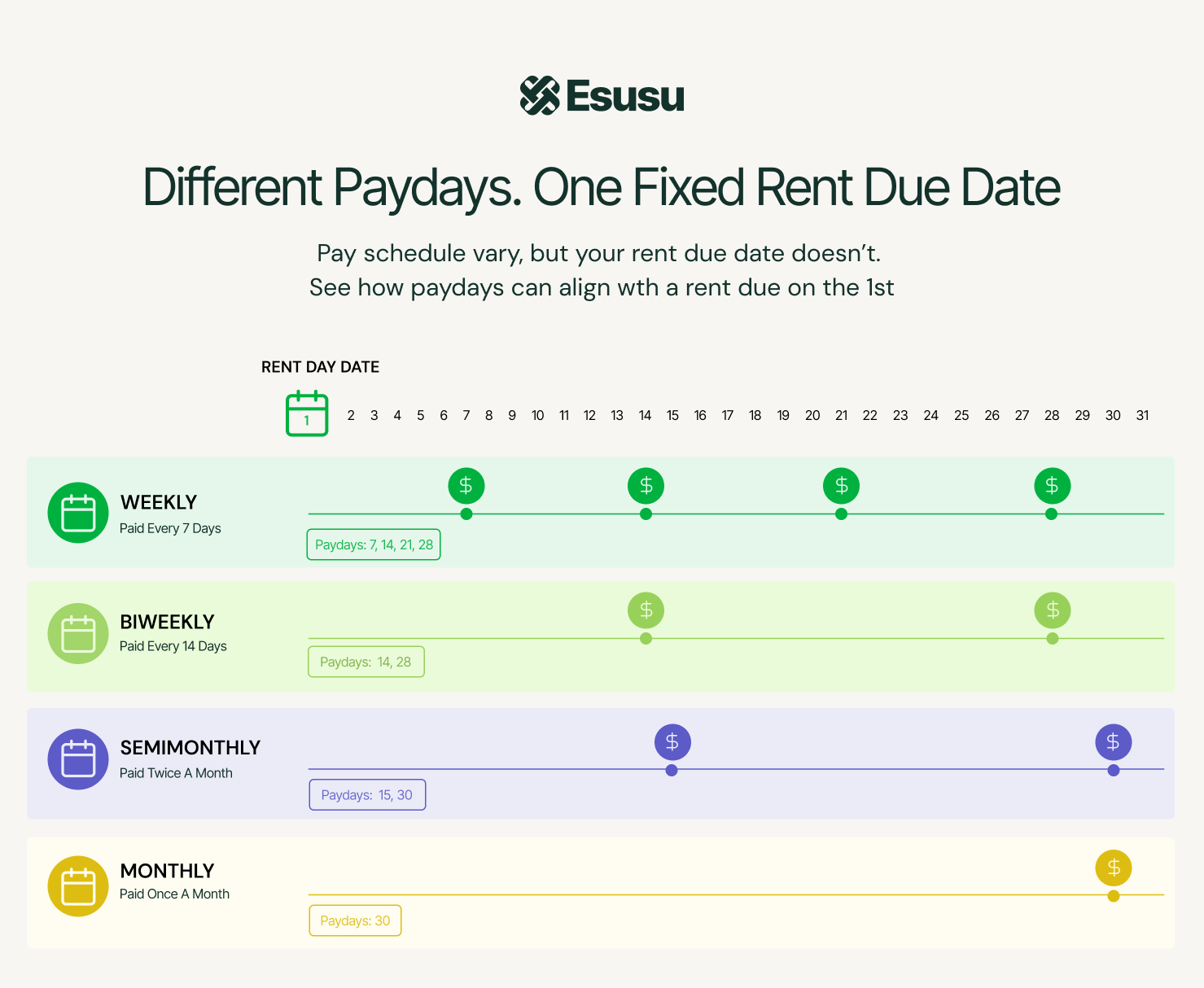
Rent usually follows a monthly cycle. Paychecks can arrive weekly, every two weeks, twice a month, or once a month.
According to the U.S. Bureau of Labor Statistics, biweekly pay was the most common schedule among private establishments in February 2023, used by 43.0% of establishments. Weekly pay was used by 27.0%, semimonthly pay by 19.8%, and monthly pay by 10.3%.
This tracks closely with our recent survey data, where 69 out of 104 respondents reported getting paid on a biweekly basis.
A biweekly paycheck also does not arrive on the same two dates every month. One month, a paycheck may arrive several days before rent is due. Next month, the next paycheck may arrive shortly after the first.
The renter’s monthly income may not have changed. The rent may not have changed either. The timing did.
This is one reason a monthly budget is not only about income versus expenses. It is also about when income arrives and when bills need to be paid.
A Late Rent Payment Can Be a Timing Problem
When rent is paid late, it can be tempting to assume the renter simply did not budget correctly. Sometimes, the explanation is more complicated.
Imagine rent is due on Tuesday, but a paycheck arrives on Friday. The renter may have enough money to cover the full expense within the same week, but there is still a gap between the bill and the income intended to cover it.
In our survey, we asked renters who experience this gap how often it causes an issue. Out of 67 respondents, 38 said it causes an issue "every month," and another 19 said "most months." This means that for those facing a mismatch, the struggle is a consistent, recurring hurdle.
This kind of mismatch is not unique to rent. The Consumer Financial Protection Bureau (CFPB) has noted that bill due dates do not always align with paychecks and that some consumers may benefit from asking billers about different due dates or payment arrangements.
That does not mean paycheck timing explains every late payment. Unexpected expenses, payment habits, income changes, and other circumstances can also play a role. A late payment alone does not explain a renter’s financial situation.
When Timing Is Off, Late Fees Can Add Another Expense
A few days can have a financial cost.
In a January 2025 analysis, the CFPB examined rental payment data covering September 2021 through November 2024. In November 2024, about 14% of active renters in that dataset had incurred at least one late fee during the previous 12 months.
The average late fee was about $84 in November 2024. Among renters who incurred at least one late fee, just under 60% incurred two or more during the 12-month period.
These figures describe the CFPB’s rental payment dataset, which is not designed to represent the entire U.S. renter population. They also do not show why each payment was late, so they cannot establish that paycheck timing caused the fees.
They do show how a short payment gap can become another expense in an already tight monthly budget.
There May Not Be One Perfect Rent Due Date
A renter paid weekly has a different cash-flow calendar from someone paid twice a month. A person paid biweekly may receive paychecks on different dates from one month to the next. A single fixed rent due date cannot perfectly match every income schedule.
That is why flexibility may be more useful than searching for one ideal date.
In fact, when we asked renters if flexibility would be useful for things like a slow month or an unexpected expense, 91 out of 99 respondents said yes.
For renters, flexibility can create more options for managing the space between income coming in and bills going out.
Changing a lease’s due date may be possible in some situations, but it depends on the lease, the property, and the property manager. Renters should review their lease and ask what options are available before assuming a change can be made.
How Esusu Pay Can Help With Rent Timing
For eligible renters at participating properties, Esusu Pay offers flexible options for splitting rent into smaller payments within the same billing cycle. It does not change the amount of rent owed or automatically change the lease’s due date.
Esusu is not a bank. Lending services are provided by third-party partners, including Affirm and Stable Home Fund. Esusu Pay and rent-splitting features are subject to eligibility and approval, and availability may vary by property.
So make rent work better with your schedule. See whether Esusu Pay is available to you and learn more about flexible rent payment options.


.png)

