



Applying for a rental can feel stressful. You may need to compare homes, gather documents, pay an application fee, and wait for a screening decision.
It is also easy to feel unsure about which charges are normal and what a landlord should tell you before you apply.
Colorado has rules that affect rental prices, application fees, and tenant screening.
These rules are designed to make the rental process clearer and give renters more information before they spend money on an application.
This guide explains what renters should know when applying for a home in Colorado.
It covers rental application fees, total rental costs, Portable Tenant Screening Reports, screening decisions, and steps you can take to protect your records.
It is for general information only, not legal advice. If you have a question about your situation, consider contacting a qualified housing or legal resource.
Key takeaways
- Review the total rental price, not only the advertised base rent. Some required charges may need to be shown clearly before you apply.
- A rental application fee should be connected to the landlord’s cost of processing the application. It should not be treated as extra profit.
- Before collecting an application fee, a landlord should provide written tenant-selection criteria and information about possible reasons for denial.
- A qualifying Portable Tenant Screening Report, or PTSR, may give you another way to apply without paying a new application fee.
- When you provide a qualifying PTSR, a landlord generally cannot charge an application fee or a fee to access or use the report.
- A PTSR does not guarantee approval. A landlord may still apply lawful, written, and consistent screening criteria.
- Keep copies of listings, fee disclosures, receipts, reports, emails, and other application records.
Start with the total rental price
A rental listing may show a monthly rent amount in large numbers. That number may not include every charge you will have to pay. Before applying, look for a clear explanation of the full cost of renting the home.
Colorado’s HB25-1090 addresses price transparency and certain charges in residential rental agreements.
In general, a landlord should make the total price clear when advertising a property. The total price may include charges that you must pay to rent, use, or enjoy the property, as well as charges that you cannot reasonably avoid.
For example, a listing may show base rent of $1,500 per month. If every resident must also pay a $30 trash charge and a $15 technology charge, the listing should not make $1,500 look like the complete monthly price. The required charges should be explained clearly so you can understand the amount you may owe.
This does not mean every extra service is illegal. Some services may be optional, such as premium parking, storage, or a pet-related service.
The important questions are whether the service is truly optional, whether you can reasonably avoid the charge, and whether the price and terms are described accurately.
Questions to ask before applying
Before you pay an application fee, ask:
- What is the total monthly price for this home?
- Which charges are required for every resident?
- Which services are optional?
- Are utilities fixed, estimated, or based on actual use?
- Is there a separate security deposit, move-in fee, pet charge, or parking charge?
- Will any fee change after I apply or sign the lease?
You may not get every answer in the listing. Asking these questions in writing can help you compare homes and keep a record of what you were told.
How Colorado rental application fees work
Colorado landlords may charge a rental application fee when the fee is used to cover permitted costs of processing the application.
Under Colorado’s Rental Application Fairness Act, the fee should be based on actual processing costs or, in some situations, an average cost per applicant when multiple applications are processed.
The fee should not be set as a general revenue source. It should be connected to the work involved in processing applications, such as screening and related administrative steps.
Before collecting the fee, the landlord should provide written information about the tenant-selection criteria and the grounds on which an application may be denied.
The landlord should also provide the required disclosure about anticipated expenses or an itemization of actual expenses, along with a receipt.
If the landlord does not use the full amount of the fee for permitted application-processing costs, the unused portion generally must be returned within the applicable timeframe.
Colorado law also refers to a good-faith effort to return the unused amount within 20 calendar days after processing the application. The exact process may depend on the facts and the landlord’s workflow.
What should you receive after paying?
Save the following items whenever possible:
- The rental listing as it appeared when you applied
- Written tenant-selection criteria
- Any explanation of application costs
- Your payment receipt
- Emails or messages about the application
- Copies of documents you submitted
- Any notice about approval, denial, or a refund
These records can help you understand the process and ask clearer questions if the fee or screening result is confusing.
When should you pause before paying?
Consider pausing and asking for more information if:
- The landlord will not explain what the application fee covers.
- The listing shows a low rent but does not explain required charges.
- You are asked to pay a fee before receiving tenant-selection criteria.
- The amount changes without an explanation.
- You are told the fee is refundable, but the terms are not provided in writing.
- You are asked to pay a separate charge just to have a screening report reviewed.
A question or missing detail does not automatically mean a landlord has violated the law. It does mean you may want to understand the charge before moving forward.

What is a Portable Tenant Screening Report?
A Portable Tenant Screening Report, or PTSR, is a consumer report prepared at the request and expense of a prospective tenant for use in rental applications.
A qualifying report generally includes information such as:
- Identity information
- Employment and income verification
- Rental history
- Credit history
- Criminal history
- The date through which the information is current
The goal is to make a screening report reusable.
Instead of paying for a new report each time you apply, you may be able to provide a qualifying report to more than one landlord.
Colorado’s HB23-1099 established requirements related to Portable Tenant Screening Reports.
The later HB25-1236 updated parts of the screening process, including rules that affect applicants using housing subsidies.
Do landlords have to accept a PTSR?
Generally, a landlord must accept a qualifying PTSR, subject to the requirements and exceptions in the law.
A landlord may require that the report was prepared within the previous 30 days. They may also require the report to include the information required by law and a statement from you that there has not been a material change in the relevant information since the report was prepared.
A landlord may have a process for reviewing a renter-provided report.
That process may include checking your identity, the report’s origin, the preparation date, the required report components, and whether the information matches your application.
The purpose of verification should be to confirm that the report is valid and connected to you. A landlord should not use verification as a reason to reject every renter-provided report or force every applicant to use one specific paid provider.
Can a landlord charge a fee when I provide a PTSR?
When you provide a qualifying PTSR, the landlord generally cannot charge you a rental application fee or a fee to access or use the report.
The landlord should tell you about the PTSR option before taking the screening step that would normally lead to an application fee.
This timing matters. The information should not appear only after you have already paid.
Look for the notice in the listing, property website, application page, email, or other instructions you receive before applying.
A PTSR does not mean you will automatically be approved. The landlord may still review the report and apply written, lawful, and consistently used tenant-selection criteria.
Can a landlord require a specific screening company?
A landlord may offer a screening or verification option. However, you generally should not be required to use one specific paid provider as a condition of submitting a qualifying PTSR.
If a landlord says you must use a particular service, ask whether you can provide your own qualifying report instead. Keep the answer in writing.
If you believe the process does not give you the option described by Colorado law, consider contacting a qualified housing or legal resource.
What renters using housing subsidies should know
Housing-subsidy applicants may have different screening needs.
Under HB25-1236, a qualifying PTSR for an applicant who is seeking to rent with housing assistance does not need to include a credit history report, credit score, or adverse credit event.
This does not mean a landlord must ignore every screening factor.
It does mean that a missing credit score should not automatically cause an application to fail when the law does not require that information in the qualifying report.
If you use a housing subsidy, ask:
- Which documents do you need to show eligibility?
- Which screening criteria apply to all applicants?
- How will the landlord review income from the subsidy and other income sources?
- Can you provide a qualifying PTSR?
- What happens if a credit score is not included in the report?
Keep copies of your subsidy documents and written answers.
If you are unsure whether a screening practice affects your rights, seek advice from a qualified housing or legal organization.
What landlords may still review
Colorado’s screening rules do not guarantee approval.
A landlord may still use written criteria to review an application. These criteria may include income, employment, rental history, identity, credit information, criminal history, or other information allowed by applicable law.
The criteria should be explained before you pay an application fee. They should also be applied consistently to similar applicants.
Ask for the criteria in writing if you do not already have them. Look for information about:
- Minimum income requirements
- How income is calculated
- Accepted income sources
- Credit history requirements
- Rental history requirements
- Criminal history review
- Occupancy limits
- Required documents
- Possible reasons for denial
A qualifying PTSR can help you submit screening information without paying a new application fee, but it does not remove the landlord’s responsibility to review the application under the stated criteria.
Download the Esusu app and explore tools that may help you build credit through eligible on-time rent payments.
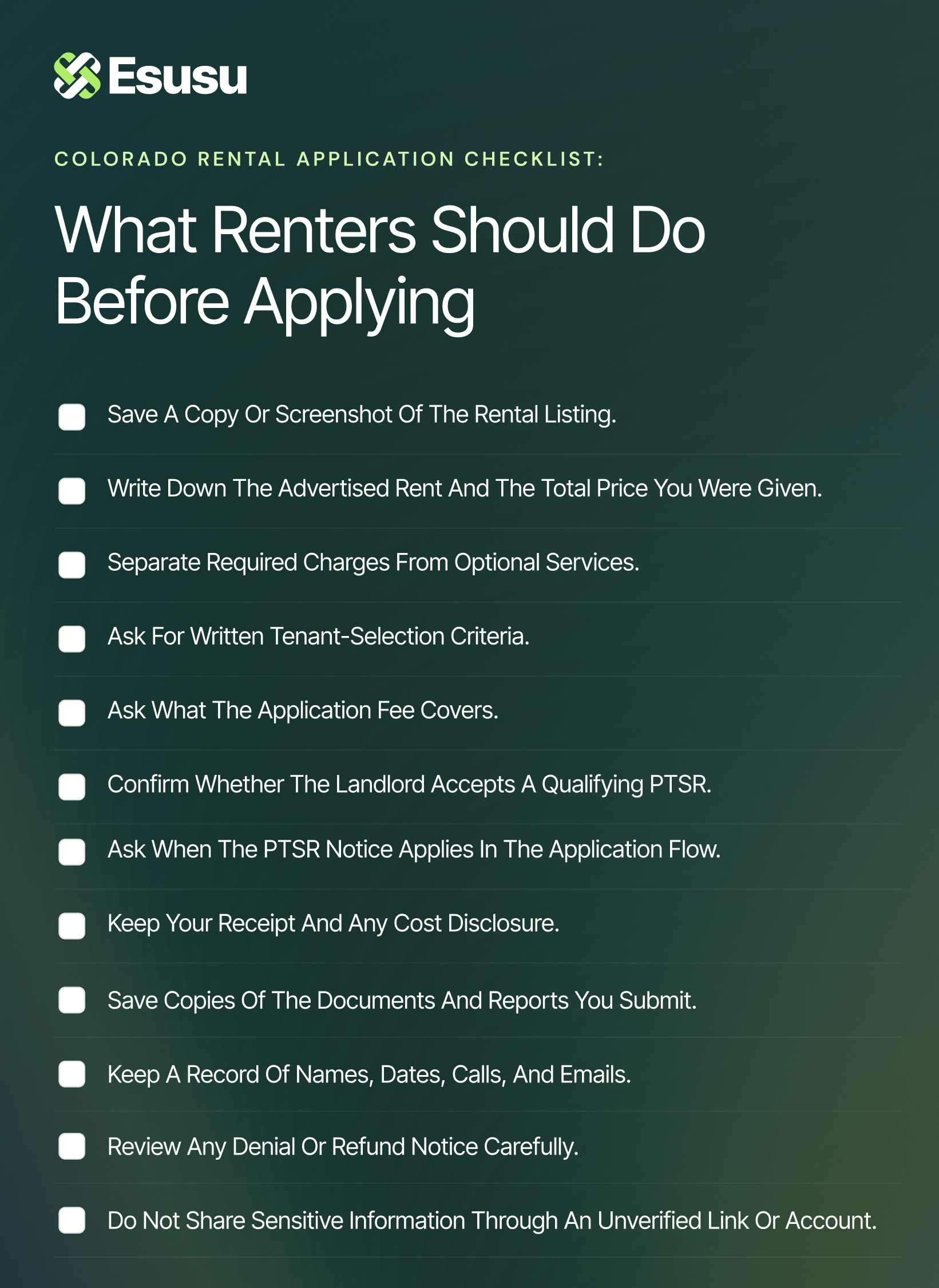
A practical Colorado rental application checklist
Use this checklist before and during the application process:
You can also ask whether the landlord has a secure way to submit documents.
Identity and income information can be sensitive, so check the website address, confirm who will receive the information, and avoid sending private documents to an unknown contact.
What to do if a fee or screening step is unclear
Start by asking a short, specific question in writing. For example:
“Could you please confirm the total monthly price, which charges are required, what the application fee covers, and whether I may provide a qualifying Portable Tenant Screening Report instead?”
Save the response. If the answer is incomplete, ask for the written tenant-selection criteria and the fee disclosure before paying.
If you believe you were charged a fee that was not explained, charged for access to a qualifying PTSR, or denied the opportunity to provide a qualifying report, keep all related records.
You may want to contact a qualified housing counselor, legal aid organization, or attorney for guidance about your specific situation.
You can also review the official text of the relevant laws through the Colorado General Assembly. Legal requirements can change, and exceptions may apply to individual situations.
How Esusu can support your financial goals
Renting a home is more than finding a place to live. Your rent payment can also be part of your broader financial plan.
At Esusu, we offer tools that can help eligible renters report rent payments to credit bureaus and explore financial wellness resources.
Reporting does not guarantee a specific credit score or result, and availability may depend on eligibility and property participation.
If you are already applying for a home, focus first on understanding the price, the application process, the screening criteria, and the documents you are being asked to provide.
Once you rent, you can explore whether rent reporting is available to you and how it fits your goals.
Download the Esusu app to see whether our rent reporting and financial wellness tools are available to you.
Frequently Asked Questions About Colorado Rental Application Fees
DISCLAIMERS:
This article is for general informational purposes only and does not constitute legal advice. Colorado laws and guidance may change. Consult a qualified attorney, housing counselor, or legal aid organization about your specific situation.
Esusu only reports on-time rent payments and does not report missed or late rent payments to the credit bureaus. Using Esusu rent reporting services does not guarantee an increase in credit scores or approval for any credit product, as scores are determined by credit agencies using multiple factors including payment history on other accounts, credit utilization rates, and other variables. Individual results vary and are not guaranteed.


