






.png)
Rent is often the largest bill in a household, yet historically it has not helped most renters build credit. Rent reporting changes that by turning your monthly rent payment into a tradeline the credit bureaus can see without taking on new debt to do it.
The Quick Answer: How You Build Credit Faster With Rent Reporting
Esusu turns your monthly rent payment into a rental tradeline on your credit report, making your rent payment history part of your credit file and visible to the credit bureaus. On-time rent payments can be reported to all three major credit bureaus: Equifax, Experian, and TransUnion, and treated like any other line of payment history on your credit reports.
Many Esusu renters have seen their credit score climb meaningfully, with an average credit score increase of 53 points* for residents who consistently report their rent payments. While individual results will vary based on your unique credit profile, establishing a consistent rental tradeline offers a powerful foundation for growth.
The unlock is simple: rent builds your credit with no new credit account required. With Esusu, only on-time rent payments are reported to the bureaus, so missed payments through the platform are not used to lower your credit score.
The Esusu app validates your address in about 30 seconds and tells you whether your rent payments are already qualified for free rent reporting as a resident benefit through your rental community, or whether you need to self-enroll, which you can also do in the app.
Once you’re enrolled, all you have to do is just keep paying rent on time as always!
How Does Rent Reporting Build Credit?
Rent reporting is simply the process of submitting your monthly rent payment to the major credit bureaus so it becomes part of your credit file, which historically did not include rent data. It adds your rent payment history as a tradeline, similar to a loan or credit card account on your credit report.
It’s important to note that rent payments do not appear on a credit report automatically.
A rent reporting service has to submit the rental payment information for you. You can either opt in through your landlord if they already work with a rent reporting service, or you can just sign up directly on your own through rent reporting apps like Esusu, even if your landlord does not offer our service as a resident benefit.
In other words, just like millions of other renters, you can use Esusu to build your credit with rent reporting, regardless of whether your landlord offers rent reporting or not.
.png)
Why Is Rent Reporting Important for Building Credit History?
Rent reporting is important for building credit history because your payment history is the largest factor in many of the most popular credit scoring models, including: 35% of your FICO® Score and 41% of your VantageScore, according to those credit bureaus. That makes consistent on-time payments powerful for renters who want to build credit history. VantageScore 3.0 and 4.0 and FICO 9 and 10 natively factor in reported rent data, while FICO 8 does not. Each credit scoring model treats rent data differently, so your reported rent will affect some credit reports more than others.
The bigger shift is happening in mortgage underwriting itself, and it accelerated dramatically in 2026.
In April 2026, the FHA, Fannie Mae, and Freddie Mac jointly announced they are adopting VantageScore 4.0 and FICO 10T, their first new credit scoring models for mortgages in decades, and Fannie Mae and Freddie Mac began immediately accepting Vantage-scored loans from approved lenders.
Both of those new scoring models natively factor in rent payment history, which means the rent you report today can lift the credit score a mortgage lender pulls and play a more direct role in qualifying for a government-backed mortgage than it ever has before.
The shift built on earlier policy changes that are still in effect: the FHA began requiring lenders to factor positive rental payment history into its TOTAL Mortgage Scorecard in March 2023, Fannie Mae’s Desktop Underwriter® has used 12 months of positive rent payments since 2021 (with a major upgrade in early 2025), and Freddie Mac’s Loan Product Advisor® uses a comparable approach. In all of these systems, only on-time rent payments help the applicant — missed payments are not held against them.
To sum it all up: For low credit, or credit-invisible renters, building your credit through rent reporting is a major asset because it adds positive payment history to your overall credit profile without requiring you to take on any new debt.
For more beginner-friendly options, our guide on how to build credit with no credit history walks through other ways to start building from scratch.
How Rent Reporting Functionally Works
Esusu connects renters, landlords, and the three credit bureaus through automated rent reporting. If you sign up through a landlord that partners with Esusu, rent is charged through your property’s normal system, you make the rent payment, and Esusu receives confirmed payment information from the property data feed; then reports eligible payments to the credit bureaus each month.
If you sign up independently of a landlord, you connect the bank account you use to pay rent inside the Esusu app. Esusu identifies your monthly rent payment automatically and reports it to the bureaus.
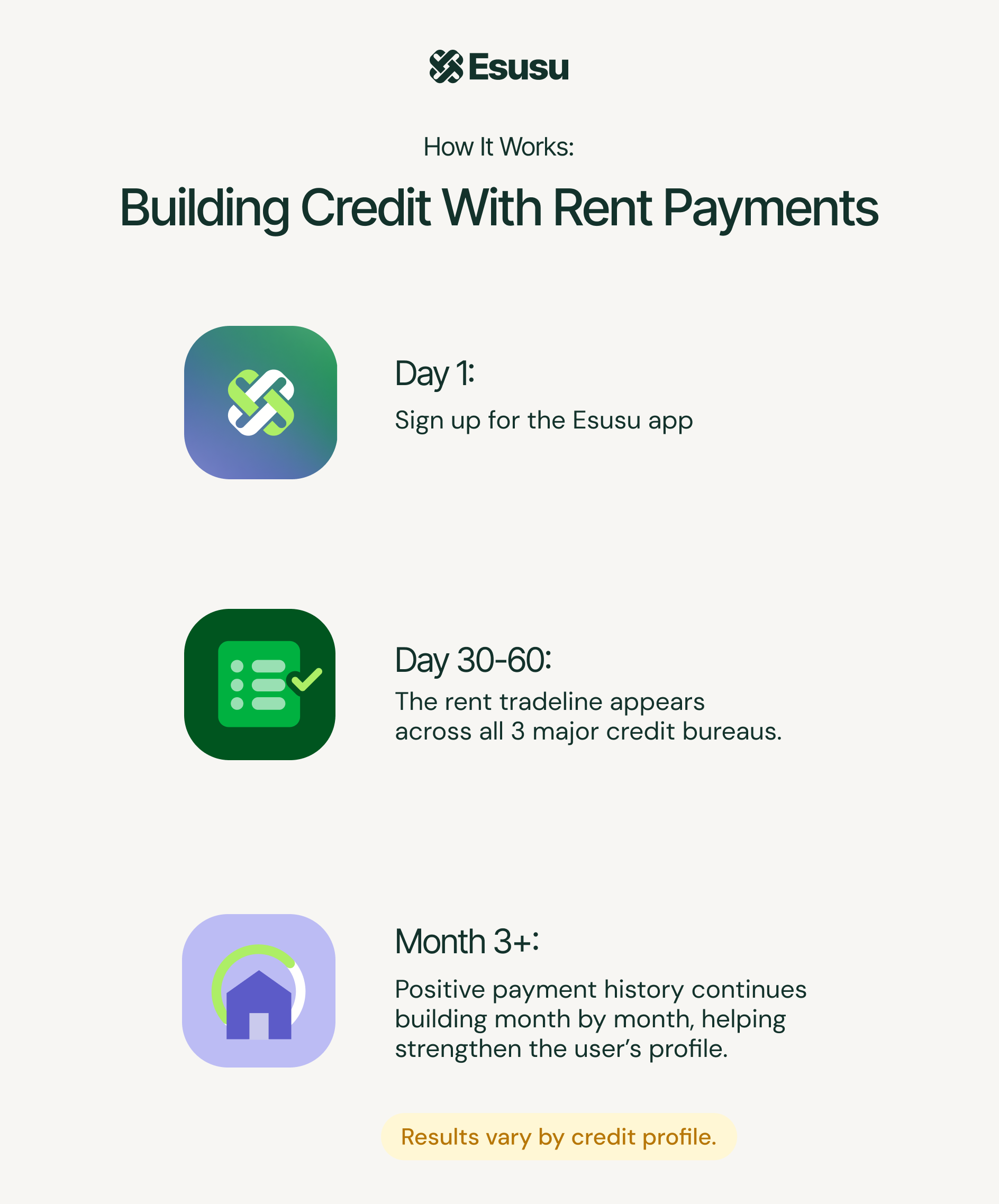
Esusu typically creates a rental tradeline within 30 to 60 days after enrollment, and most renters see the tradeline appear on their credit reports roughly 30 days after their first reported rent payment.
Esusu can often include up to 24 months of past rent payments when reliable records exist, which helps build credit history significantly faster than if you were starting from scratch.
A reported rental payment shows up as a dedicated account on your credit report, typically labeled “rental,” “residential,” or by the provider name, with the open date, monthly rent amount, recent payments, and a month-by-month grid of on-time activity.
After your first month of reporting, pull your credit report from all three of the credit bureaus through AnnualCreditReport.com to confirm the tradeline is accurate.
You can also download your credit report via the Esusu app every month to stay on top of your credit.
How Long Until Your Rent Affects Your Credit Score
This is one of the questions almost every renter asks first.
The first reported rent payment typically appears on your credit report within 30 to 60 days of when you enroll and start reporting your rent payments. From there, building positive payment history is a compounding process. Each on-time monthly rent payment adds another month of timely rent payments to your credit file.
How much your credit score moves depends on what your credit file looked like before. Renters with a thin file or no rental history at all tend to see the biggest credit rent boost, because their credit score has more room to move when positive payment history starts arriving.
Two things help maximize the impact:
- Pay all your accounts on time, every month. A single payment over 30 days late on a full-file reporting service can offset months of positive credit history. Esusu’s standard approach focuses on reporting on-time rent payments only, so a missed payment through the platform is not used to lower your credit score, but that doesn’t mean you can make late payments on any of your other credit accounts.
- Keep credit utilization low elsewhere. Rent reporting builds payment history, the biggest credit scoring factor, but credit utilization is the second-biggest. Pairing positive rent payments with low utilization on your other credit accounts can be a fast way to build credit and see your score move.
Eligibility and Coverage: Bureaus, Leases, and Past Rent
Which credit bureaus accept rent data?
The three major credit bureaus: Equifax, Experian, and TransUnion. All accept rent payment data from a rent reporting service or credit reporting agency. The catch is that not every service reports to all three. Esusu reports to all three major bureaus, which maximizes visibility across your credit profile no matter which credit bureau a lender pulls from.
Can you report past rent payments?
Yes, in many cases. Some rent reporting services allow tenants to report up to 24 months of past rent payments, which helps establish a credit history more quickly than waiting a year for a new tradeline to mature. Backfilling past payments may require documentation — a lease, bank statements, or payment receipts proving consistent monthly payment activity — and some services charge a one-time fee for it.
What kinds of leases qualify?
Most standard residential leases qualify. Month-to-month leases generally work as long as a consistent monthly rent payment can be verified. Rent payment information from sublease arrangements, roommate splits, and units where a tenant pays rent with rental assistance can be more complicated and depends on how each service handles them — with Esusu, the app will walk you through identifying your monthly rent payments. If you have a unique rental scenario, you’re welcome to reach out to our support team to better understand how to account for it.
The Three Paths to Rent Reporting
There are essentially three ways to turn your rent into credit, and the right one depends on where you live and how involved you want to be.
Path 1: Free through your landlord
A growing number of property managers offer rent reporting as a resident benefit, where the landlord covers the cost and rent reporting is free for the renter. If your community partners with a rent reporting service, this is almost always the best option: no monthly fee, no setup work, and the rental payment information flows automatically from the property’s rent collection system to the credit bureaus, where it can lift your credit score.
Path 2: Direct sign-up with a rent reporting service
If your building does not offer rent reporting, you can sign up on your own via the Esusu app. You pay a monthly or annual fee, link your bank account, and the service verifies and reports your monthly rent payment to the three major credit bureaus. This path gives you control but costs money, typically $4.99 to $10.95 per month.
Caution: Just be careful because some apps offer low initial rates on the sign up page, but then hit you with significant upsell charges to add things like the 24-month rent reporting look back. At Esusu, things like the 24-month look back are included for free in every membership plan.
Path 3: Self-report through a payment platform
A handful of services let you route your monthly rent payment through their platform and report the payment as part of the transaction. This works for renters whose landlord won’t participate.
Caution: The trade-off with payment platforms is that you tie your rent payment method to a single platform, and if you ever stop using it, the tradeline can end with it. This can have a negative impact on your credit, so choose wisely. With Esusu, you can take your rent reporting anywhere. You never have to worry about whether our service is available at your next rental home or not.
Find out which path is yours
The Esusu app validates your address automatically and tells you whether you’re already covered through your building or need to self-enroll. Either way, once you enroll, you have access to a wealth of financial wellness benefits that extend beyond rent reporting.
The benefits available on your plan are based on your rental location, and range from access to split rent payments to line up your rent with your paycheck, tax filing with April, membership savings on everyday purchases, and one-on-one personalized financial coaching to help you erase debt, strengthen your credit profile, build your savings and investments, and so much more.
Comparing Rent Reporting Services
Most renters end up comparing a handful of options. Here are the options that actually matter.
Bureau coverage
A tradeline that only appears on one credit report is invisible to a lender pulling from another. Esusu reports to all three bureaus. Some competing services, including Flex and Rental Kharma, do not report your rent payments to all three major bureaus.
Cost
Pricing for rent reporting services varies from free (if your landlord covers it) to roughly $10 a month. Watch for one-time backfill costs of $25 to $99 for reporting past rent payments, which some services charge on top of the monthly fee. At Esusu, it’s included in our membership at no additional cost.
Late payment policy
The single most important question to ask before signing up. A full-file rent reporting service notifies credit bureaus of both positive and negative behaviors, meaning a single late rent payment over 30 days can show up as a derogatory mark and harm your credit score. Esusu reports on-time payments only by default, which protects your credit score from one bad month.
Live customer support
When something looks wrong on your credit reports, you want a human to call. Unfortunately, a lot of rent reporting services available today do not offer live customer support with a real human, and many only offer AI-based, self-help support. Esusu is one of the few services that offers live customer phone support with a real human being in addition to email, AI-based support, text, and chat.
Where the major services differ
Boom, Bilt, Rental Kharma, RentReporters, and Esusu all offer some form of rent reporting, but bureau coverage, customer support, fee models, and late payment reporting policy differ across each — and so does the potential credit score impact.
The right rent reporting service for you depends on whether your building already partners with one (free) versus needing to self-enroll, and whether you want the protection of on-time-only reporting.
A Note on California and AB 2747
California renters have an additional option. Under AB 2747, effective in 2025, landlords with 15 or more units in California are required to offer tenants the option to have their on-time rent payments reported to at least one major credit bureau. The law does not make rent reporting automatic; tenants have to opt in. If you rent in California, ask your leasing office which rent reporting service they offer, or simply download the Esusu app today and start taking advantage of the one thing you already pay every single month, and put it to work to build your credit history. Learn more about AB 2747.

Common Mistakes to Avoid
Signingup for a service that only reports to one of the credit bureaus. If your lender pulls from a different one of the credit bureaus, your tradeline is invisible. Confirm coverage before paying anything.- Paying for a 24-month backfill when your lease is only two months old. There is nothing to backfill yet, so do not pay for the add-on. And remember, with Esusu, that 24-month reporting backfill is already included in your membership.
- Confusing rent reporting with rent splitting or “buy-now-pay-later for rent” products. Those are different services with different effects on your credit score. Only rent reporting builds credit history. And depending on where you currently rent, Esusu’s split rent service may already be available to you in the app. If it’s not, don’t worry! We’re expanding access to it quickly. Be the first to know when it’s available at your rental by signing up for the Esusu Pay waitlist in the app.
- Assuming a late rent payment will not be reported. With a full-file rent reporting service, it will be. Read the policy. At Esusu, we only report on-time rent payments.
- Cancelling rent reporting mid-lease. Some services close out the tradeline when you cancel, which can erase the rental payment history you have already built. If you can, pay for an annual rent reporting plan to avoid any disruption in your rent reporting history. Esusu offers an annual plan specifically for this reason.
Frequently Asked Questions
Your Next Step
Whether your building partners with Esusu or you are enrolling on your own, the Esusu app handles the lookup automatically. Enter your address, see your options, and start reporting your monthly rent in a few taps. No credit check. No commitment. If you are already covered through your building, the core plan is free.
* Based on active renters at active properties from enrollment through Q4 2025. Average credit score increase calculated by comparing enrollment credit score to latest available credit score as of Q4 2025, treating renters with no credit score at enrollment as having a score of zero. Esusu only reports on-time rent payments and does not report missed or late rent payments to the credit bureaus. Using Esusu rent reporting services does not guarantee an increase in credit scores or approval for any credit product, as scores are determined by credit agencies using multiple factors including payment history on other accounts, credit utilization rates, and other variables. Individual results vary and are not guaranteed.


.png)

