


Colorado landlords and property managers are operating under updated rules for rental pricing, application fees, and tenant screening.
As of January 1, 2026, HB25-1090 and HB25-1236 are in effect. Colorado’s Portable Tenant Screening Report requirements under HB23-1099 have been in effect since August 7, 2023. These laws build on the application-fee requirements established by HB19-1106.
Together, these rules affect how you advertise rent, disclose mandatory charges, collect application fees, accept Portable Tenant Screening Reports (PTSRs), and evaluate applicants who use housing subsidies.
This guide explains the operational changes landlords should understand in 2026 and how technology can support a more transparent, efficient leasing process.
It is for informational purposes only and is not legal advice. Review your process with qualified Colorado counsel before relying on this guide for compliance decisions.
Key takeaways
- Advertise the total price clearly. HB25-1090 generally requires pricing information to show the total price as a single, prominent number, subject to statutory exceptions.
- Do not treat application fees as a revenue stream. Under Colorado’s Rental Application Fairness Act, an application fee must be used for the landlord’s costs of processing the application.
- Tell applicants about PTSRs before collecting information that would generate an application fee.
- Do not charge an application fee or a fee to access or use a qualifying PTSR.
- Use a consistent, documented screening process. Tenant selection criteria, fee calculations, receipts, refunds, and denial notices should be handled through a repeatable workflow.
- Update screening for housing-subsidy applicants. A qualifying PTSR for an applicant using a housing subsidy does not need to include a credit history report, credit score, or adverse credit event under HB25-1236.
- Treat verification technology as support, not as a substitute for legal compliance. A platform can reduce manual work and help verify information, but it cannot guarantee compliance by itself.
Which Colorado laws apply to landlords?
Here’s a quick look at the Colorado laws that shape rental pricing, application fees, and tenant screening, and the operational updates each one requires from landlords and property managers.

These laws address related but different parts of the rental process. A landlord can comply with one requirement and still have a gap in another.
For example, showing a total advertised price correctly while using an outdated PTSR notice in the application flow.
HB25-1090: Colorado’s fee transparency and total-price rules
HB25-1090, titled Protections Against Deceptive Pricing Practices, requires a person offering, displaying, or advertising pricing information for property to clearly and conspicuously disclose the total price as a single number.
The total price generally includes amounts a tenant must pay to purchase, enjoy, or use the property, as well as amounts that are not reasonably avoidable.
The total price should be more prominent than other pricing information. Landlords should not advertise a low base rent and then reveal mandatory charges only later in the leasing process.
For example, if a listing advertises $1,500 in rent and the tenant must also pay $30 for trash service and $15 for a mandatory technology fee, the listing should make the applicable total price clear rather than presenting $1,500 as the complete monthly cost.
The law has exceptions and special treatment for certain charges, including some government charges and variable utility amounts.
Do not assume that every charge can be placed outside the advertised total. If a tenant cannot reasonably avoid a charge, review how it should be disclosed with counsel.
Are all rental fees illegal in Colorado?
HB25-1090 does not make every optional charge illegal. The key questions are whether the charge is mandatory, reasonably avoidable, accurately described, and disclosed at the right time.
A landlord may still offer optional services such as premium parking, storage, or pet-related services, but the price and nature of the option should be clear.
Do not label a required charge as “optional” merely because a tenant can avoid it by choosing not to rent the unit.
HB25-1090 also restricts certain charges in residential rental agreements, including some utility markups, property-tax-related charges, payment-processing charges where a cost-free payment method is not reasonably accessible, and certain increases during a rental agreement of one year or less.
Review the statute and your lease language rather than relying on a generic “junk-fee” policy.
How should landlords audit listings for HB25-1090?
Create a fee inventory for every property and compare it with your listings, application pages, lease templates, resident portal, and payment screens.
For each charge, document:
- Whether the tenant must pay it
- Whether the tenant can reasonably avoid it
- Whether the amount is fixed or variable
- When the charge first appears in the renter journey
- Who receives the money and what service it pays for
- Whether it belongs in the advertised total price
- Whether the same description appears consistently across listing sites and lease documents
A listing audit should include syndicated listings, because a compliant property-management system cannot correct a fee that remains hidden on a third-party listing page.

Colorado rental application fees under HB19-1106
Colorado landlords can still charge a rental application fee when the fee is used to cover the landlord’s costs of processing the application.
The amount may be based on actual processing expenses or, when multiple applications are processed, an average expense per applicant.
The fee should not be treated as extra revenue or set above the applicable processing cost. A landlord that collects an application fee should also provide the applicant with the required disclosure of anticipated expenses or an itemization of actual expenses, along with a receipt.
If the landlord does not use the full fee to cover application-processing costs, the unused portion must be returned within the applicable timeframe.
Colorado law also requires landlords to make a good-faith effort to return the unused amount within 20 calendar days after processing the application.
What should be disclosed before collecting an application fee?
Before accepting an application or collecting an application fee, landlords should provide written tenant-selection criteria and the grounds on which an application may be denied.
The criteria should be specific enough for applicants and leasing staff to understand how the decision will be made.
Your application workflow should also explain that the applicant may provide a Portable Tenant Screening Report and that no application fee or PTSR access fee may be charged when a qualifying report is provided.
A practical notice can appear in:
- Rental advertisements
- Property websites
- Application landing pages
- Applicant emails
- In-person or phone scripts
- The screen immediately before an application fee is collected
Use substantially similar language across channels, and keep a record of when the notice was shown.
What is the Portable Tenant Screening Reports in Colorado?
A Portable Tenant Screening Report, or PTSR, is a consumer report prepared at the request and expense of a prospective tenant for use in rental applications.
A qualifying report generally includes identity-related information, employment and income verification, rental and credit history, criminal history, and the date through which the information is current.
The report is designed to be reusable across rental applications instead of requiring a renter to pay for a new screening each time.
Do landlords have to accept a PTSR in Colorado?
Generally, yes. HB23-1099 requires landlords to accept a qualifying PTSR from a prospective tenant, subject to the requirements and exceptions in the statute.
A landlord may require that the report was prepared within the previous 30 days. The landlord may also require the report to satisfy the statutory content requirements and to include a statement from the prospective tenant that there has not been a material change in the relevant information since the report was generated.
The 2026 update in HB25-1236 changes the treatment of applicants using housing subsidies and removes the prior language that allowed a landlord to require the report to be made directly available through a consumer reporting agency or a specific third-party website.
Landlords should not turn a preferred vendor into a condition for exercising the applicant’s right to provide a qualifying PTSR.
Can a landlord charge a fee when a tenant provides a PTSR?
When a prospective tenant provides a qualifying PTSR, the landlord cannot charge the applicant a rental application fee or a fee to access or use the report.
The notice should be provided before the landlord takes an action related to screening for which the landlord would expect to collect an application fee. This makes the notice part of the front-end application experience, not an after-the-fact disclosure.
Colorado law includes a narrow operational exception for a landlord that accepts no more than one application fee at a time for a dwelling unit and refunds the total application fee within 20 calendar days after the relevant written communication.
Because the exception depends on the landlord’s actual process, confirm its use with counsel before relying on it.
Can a landlord require a renter to use Rentell or another specific provider?
Do not require a prospective tenant to use a particular paid provider as a condition of submitting a qualifying PTSR. A landlord can offer a secure verification workflow or partner option, but the process should preserve the applicant’s right to provide a report that meets Colorado’s requirements.
This distinction matters for technology providers: the goal is to make a compliant path easier, not to replace the applicant’s statutory choice with a mandatory vendor.

Housing subsidies and Colorado tenant screening
HB25-1236 is especially important for applicants who use a housing subsidy. A PTSR for a prospective tenant seeking to rent with the assistance of a housing subsidy does not need to include a credit history report, credit score, or adverse credit event.
Landlords should review screening criteria and automated decisioning rules to ensure that a missing credit score does not automatically cause an applicant using a housing subsidy to fail a screening workflow.
Also review source-of-income and fair-housing obligations with counsel and avoid using a general screening rule that has a discriminatory effect.
The U.S. Department of Housing and Urban Development’s Fair Housing resources are a useful starting point, but they do not replace advice about Colorado-specific requirements.
Document verification: reducing fraud without undermining PTSR rights
Portable screening changes the landlord’s workflow. Instead of collecting a new report through the same property-management system every time, the leasing team may receive a report through a renter-controlled sharing process or an approved screening workflow.
That creates a legitimate operational question: how can a property manager confirm that the report belongs to the applicant and has not been altered?
The answer should not be to reject every renter-provided report or force every applicant into a paid vendor. Instead, landlords can use a verification process that checks:
- Applicant identity
- Report origin and preparation date
- Required report components
- Consistency between the report and the application
- Consent and access controls
- Any material change statement required by the statute
Technology can reduce manual review, but no screening tool should promise to eliminate fraud or guarantee a leasing decision.
The property manager remains responsible for applying written, lawful, and consistently administered screening criteria.
How Esusu and Rentell can support the updated workflow
The Colorado rules create an opportunity to make the rental process more transparent for both parties. Esusu can support the broader workflow through products and infrastructure that address different stages of the resident lifecycle.
Rentell and Esusu RAAS
Rentell is a Colorado-focused portable screening provider built around a renter-controlled application experience. Esusu’s Reporting As A Service (RAAS) infrastructure can support partner integrations and secure screening workflows.
The value proposition should be framed carefully: a technology partner can help automate verification, data exchange, and fee-handling logic, but the software does not itself determine whether a landlord is compliant with every applicable rule.
Esusu Identity Services
Esusu Identity Services can support identity, income, and document-verification workflows. This is especially relevant when a leasing team needs to validate applicant information while keeping the PTSR path available.
Use this product positioning around reducing manual work and improving verification, not around “fraud-proof” approvals or guaranteed compliance.
Esusu Pay and resident payments
Esusu Pay and other payment options can help create a more flexible resident payment experience. Payment technology should make amounts, due dates, and available options clear, but a payment platform does not replace the landlord’s obligation to disclose fees correctly under HB25-1090.
Esusu is not a bank. Lending services are provided by third-party partners, including Affirm and Stable Home Fund. Esusu Pay and rent splitting features are subject to eligibility, identity verification, and approval.
Rent reporting and resident financial health
Esusu Rent Reporting can help property owners offer residents a way to build positive credit history from eligible on-time rent payments. It can also support resident financial wellness.
Esusu only reports on-time rent payments and does not report missed or late rent payments to the credit bureaus. Using Esusu rent reporting services does not guarantee an increase in credit scores or approval for any credit product, as scores are determined by credit agencies using multiple factors including payment history on other accounts, credit utilization rates, and other variables. Individual results vary and are not guaranteed.
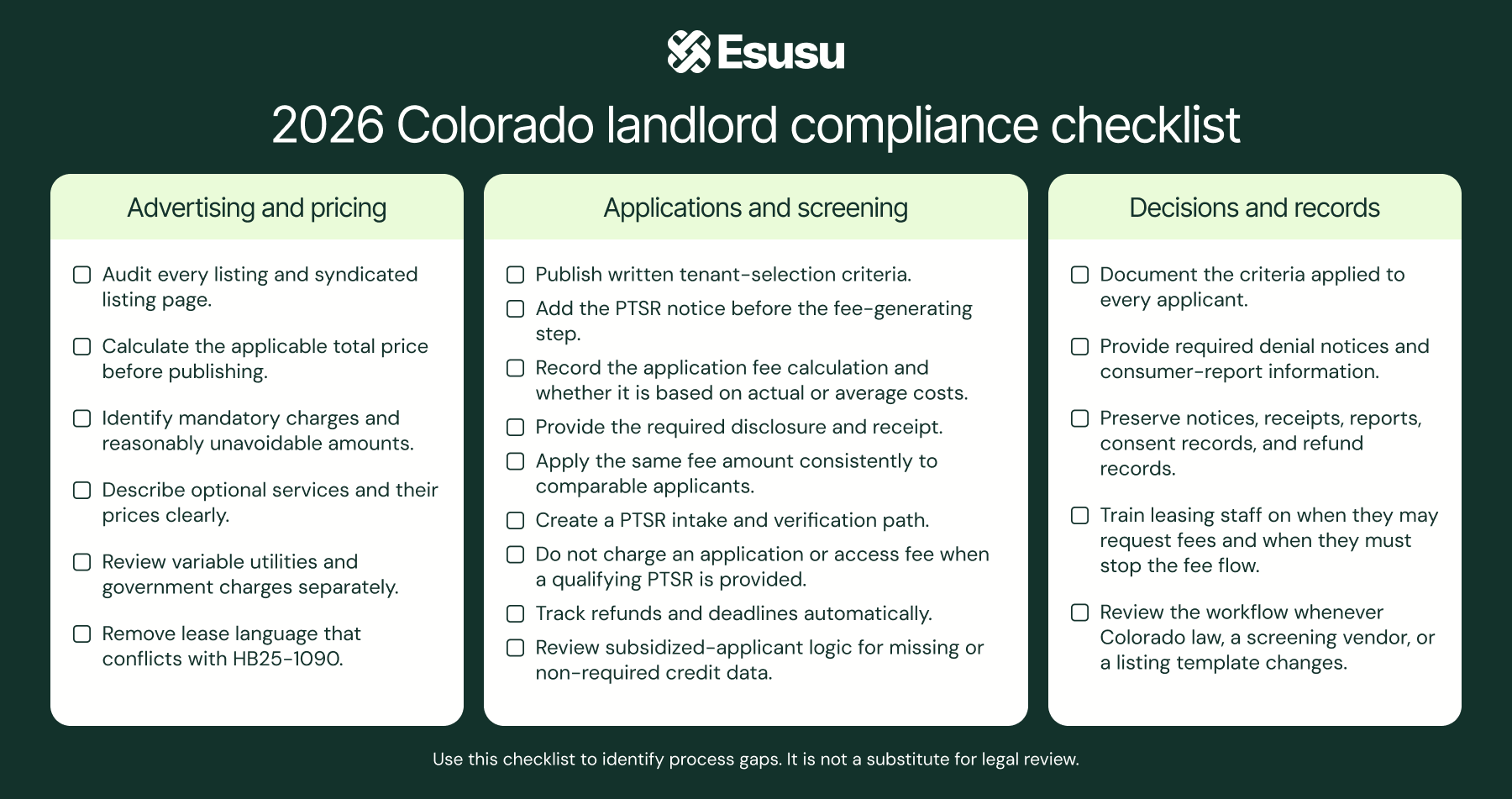
A 2026 Colorado landlord compliance checklist
Use this checklist to identify process gaps. It is not a substitute for legal review.
Talk to Esusu about Colorado rental operations
Colorado’s 2026 rules do not require landlords to choose between compliance and operational efficiency.
They do require a more disciplined process: disclose the right price, explain the applicant’s options, use cost-based fees, accept qualifying portable reports, protect applicant data, and apply screening criteria consistently.
If your organization owns or manages residential properties in Colorado, now is a good time to review the systems supporting your leasing and resident experience.
Esusu can help property owners and operators connect operational workflows across identity and income verification, resident payments, positive rent reporting, and partner integrations designed for property-management teams.
Explore Esusu’s real-estate solutions, then talk to sales to discuss how Esusu can support your Colorado portfolio.