
.svg)


.png)
When a renter applies for an apartment, property managers need a clear answer to one basic question: can this applicant reasonably afford the rent?
Income verification helps answer that question by checking the information a renter provides about their job, earnings, and financial resources.
For years, many leasing teams reviewed pay stubs and bank statements by hand. That process can work when application volume is low and documents are simple.
Today, however, rental fraud is more difficult to spot. Digital tools make it easy to create or change professional-looking documents, while leasing teams are under pressure to approve qualified renters quickly.
Income verification software gives property managers a faster and more consistent way to review income information.
It can analyze documents, support secure bank account linking, extract and summarize income information, identify signs of tampering, and support better leasing decisions.
This guide explains how the technology works, what features to look for, and how it can help protect your properties without creating unnecessary complications for applicants.
Key Takeaways
- Income verification software helps property managers review an applicant’s income and detect signs of document fraud.
- Modern rental fraud can include altered pay stubs, fake employment letters, manipulated bank statements, and stolen or synthetic identities.
- Manual review is useful, but it can be slow, inconsistent, and difficult to scale across a large portfolio.
- A strong solution should offer document analysis, fast results, clear reporting, system integrations, and responsible data handling.
- Technology should support fair, consistent screening. It should not replace human judgment or legal review.
- Esusu Identity Services uses AI-powered document analysis to help housing providers identify signs of document alteration and make faster, more confident decisions.
- Direct payroll connectivity can complement document upload and bank linking by providing income data from a connected payroll source.
- A complete workflow should support different income types, explain how affordability is calculated, and keep a clear record of each decision.
The Current Pain: The Rise of Rental Fraud
Rental application fraud is not a new problem. What has changed is how easy it can be to create convincing false information.
An applicant may use an online service to generate a pay stub that looks like it came from a real employer. Some websites advertise quick, professional-looking documents for a small fee.
Other fraudsters edit a real pay stub, change the income amount, or alter the employer name. Bank statements, tax documents, and employment letters can also be changed with widely available software.
The issue is not that every applicant is dishonest. Most renters are trying to find a home and complete the process correctly.
The problem is that one fraudulent application can create serious financial and operational risk for a property.
A leasing agent may be reviewing dozens of files while also answering calls, scheduling tours, and trying to fill vacant units. A document can look clean at first glance and still contain small inconsistencies that are difficult to see.
Industry data shows why housing providers are paying closer attention. In a 2024 survey of 75 leading apartment owners, developers, and managers, the National Multifamily Housing Council reported that 93.3% of respondents had experienced fraud during the previous 12 months.
Among those respondents, 84.3% had seen falsified pay stubs, employment references, or other income documents. The survey also found that, on average, 23.8% of eviction filings were linked to fraudulent applications and later failure to pay rent.
These numbers do not mean that every property faces the same level of risk. They do show that income fraud can move from the application stage to a costly leasing problem.
When an applicant is approved based on false information and later stops paying rent, the property may face lost income, legal and court costs, staff time, vacancy, repairs, and unit turnover.
Manual review often cannot keep up with this environment. A team member may compare an applicant’s name, employer, pay frequency, and income total. That is still useful.
But a visual review may miss metadata changes, inconsistent fonts, altered numbers, copied logos, mismatched dates, or patterns that only become clear when several documents are compared.
What Is Income Verification Software?
Income verification software is a technology solution that helps housing providers confirm whether an applicant’s reported income appears legitimate, complete, and consistent with the information submitted in the application.
Depending on the provider, the software may review uploaded documents, connect to approved data sources, or combine several verification methods. Common inputs include pay stubs, bank statements, employment letters, tax documents, and other proof of income.
Many modern workflows give applicants a choice: upload proof-of-income documents or securely link a bank account through Plaid.
Bank linking can provide first-party financial data directly from the connected institution and reduce the friction of gathering files. An applicant who wants to misrepresent income may avoid bank linking because bank-held data cannot be edited in the same way as a PDF. That is why document analysis remains essential, even when bank linking is available. Read more about Esusu’s Plaid bank linking launch.
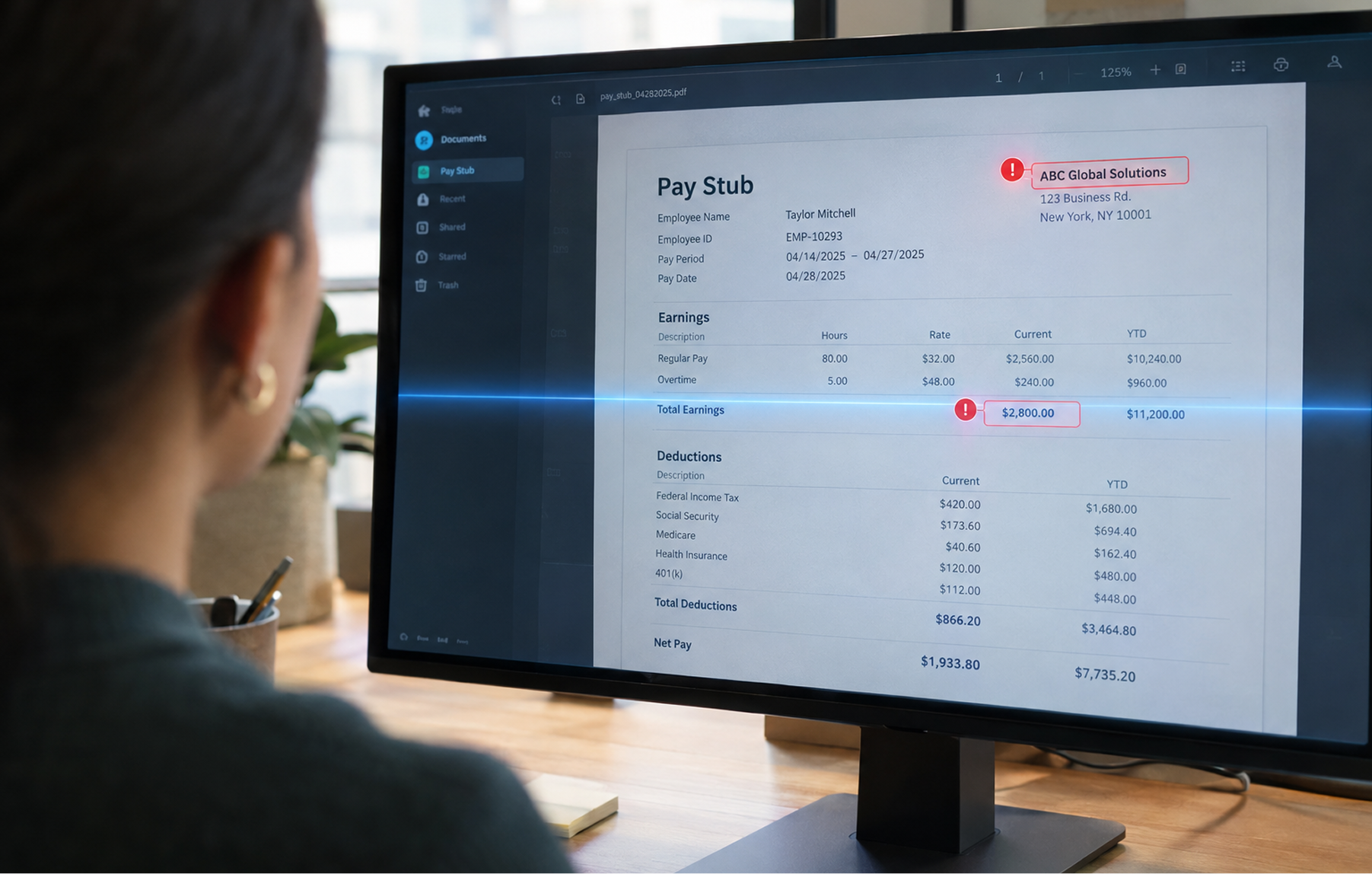
The software looks for signals that a person may not notice during a quick manual review. These signals can include unusual formatting, altered text, inconsistent calculations, suspicious dates, duplicated information, and differences between related documents.
Income verification software is not the same as a credit report. A credit report focuses on credit history and related consumer information. Income verification focuses on the applicant’s ability to show current or recent earnings and financial resources. Property managers may use both as part of a broader, consistent screening process.
It is also different from a simple income calculator. A calculator can determine whether reported earnings meet a rent-to-income policy. It does not necessarily confirm that the underlying pay stub or bank statement is real. Verification software adds an authenticity and consistency check before the numbers are used in a decision.
Income calculation takes the next step by extracting relevant income data, aggregating amounts across sources, and summarizing the results for the reviewer. This helps replace legacy processes that go document by document and line by line. Learn more in our guide to Esusu’s Income Calculator.
.png)
How Income Calculation Supports Affordability Decisions
Income verification and income calculation solve different problems.
Verification asks whether the information appears legitimate. Calculation organizes that information so a property manager can decide whether the applicant meets the property’s affordability policy.
A simple rent-to-income ratio divides verified gross monthly income by monthly rent. For example, $6,000 in monthly income divided by $2,000 in rent equals a 3x ratio. More complex applications may require the system to convert pay frequencies, combine multiple jobs, account for variable earnings, and summarize the result for human review.
The goal is not to force every applicant into the same financial profile. It is to apply a clear, consistent method while giving qualified applicants with different income patterns a fair way to document their ability to pay.
How Does the Income Verification Software Work?
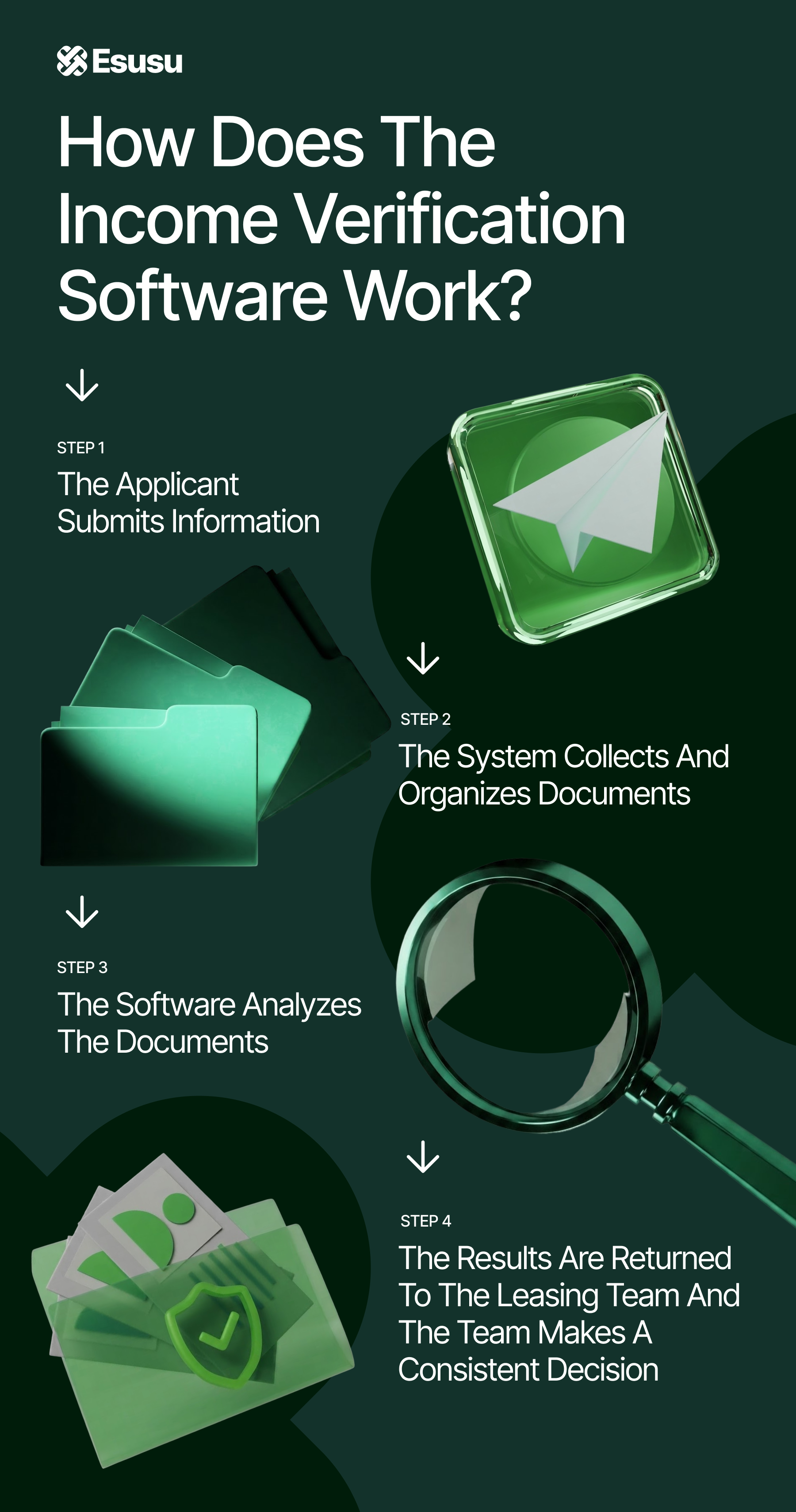
The exact workflow depends on the product and the property’s application process. A typical process includes five steps.
1. The applicant submits information
The applicant completes the rental application and provides the required income information.
This may include pay stubs, bank statements, an employment letter, or documents that explain income from self-employment, commissions, tips, benefits, or other sources.
The process should be clear about what is needed and why. A simple upload experience can reduce delays and help applicants submit complete information the first time.
2. The system collects and organizes documents
The software receives uploaded files and organizes them for review. If bank linking is enabled, the workflow can also bring in financial data from a connected account. The system may identify document types, extract key fields, and group related records together.
For applicants with multiple documents, accounts, jobs, or payment schedules, income calculation can extract relevant details, aggregate the information, and create a clearer summary.
This reduces the need for staff to open every file, search for the same details, and copy numbers into separate spreadsheets. It also creates a more consistent starting point for every applicant.
3. The software analyzes the documents
AI-powered analysis can examine the document’s structure and content.
It may look for signs of editing, unusual layers, mismatched fonts, inconsistent spacing, missing fields, or numbers that do not match the expected format.
A strong system does more than search for one visible red flag. Fraudsters can change their methods, so the technology should examine many signals at the same time.
4. The results are returned to the leasing team
The team receives a result that explains whether the information appears consistent or needs additional review.
Fast results matter because applicants may be comparing several properties, and long delays can cause qualified renters to move on.
The result should support a decision, not hide the reasoning. Leasing teams need enough information to understand what was flagged and what action may be appropriate under their policies.
5. The team makes a consistent decision
The property manager applies the same written screening criteria to every applicant. The software can provide useful evidence, but it should not be treated as an automatic approval or denial machine.
A responsible process gives staff a chance to review the full application, consider relevant information, correct errors, and follow applicable housing and consumer protection rules.
What Documents Are Used for Income Verification?
Different applicants may have different types of income.
A good process should be flexible enough to review common documents and connected accounts without assuming that every renter has a traditional salaried job.
Documents are still important, but they are not the only way to provide income information.
Pay stubs
Pay stubs usually show the employer, pay period, gross pay, deductions, taxes, and net pay. They are one of the most common documents used to verify employment income.
The review should consider whether the dates, totals, employer details, and year-to-date figures make sense together. A pay stub can look professional and still contain altered information.
Bank statements
Bank statements can show whether reported earnings appear alongside deposits in the applicant’s account. They may also help identify inconsistent balances, unusual transaction patterns, or missing deposits.
Employment letters
An employment letter may confirm a person’s role, start date, salary, or expected hours. It can be helpful for a new employee who does not yet have several pay stubs.
Tax and self-employment documents
Self-employed applicants, business owners, freelancers, and contractors may use tax returns, profit-and-loss statements, 1099 forms, or business records. These files can be more complex than a standard pay stub.
The best approach is to define acceptable documents in advance and apply the same requirements to applicants with similar income types. A policy should not make it impossible for qualified workers with nontraditional income to demonstrate their ability to pay.
Benefit and assistance documentation
Some applicants receive income from retirement benefits, disability benefits, alimony, child support, housing assistance, or other lawful sources. Policies should explain how these sources can be documented and evaluated.
Property managers should also review local rules about source-of-income protections. Screening technology should help organize information, not create a new barrier for applicants.
Verifying Freelance and Non-Traditional Income
Freelancers, gig workers, contractors, and self-employed applicants may have income that changes from month to month. A strong process can combine recent bank deposits, tax returns, 1099 forms, profit-and-loss statements, platform earnings, and other relevant records instead of relying on one pay stub.
The review should look at consistency over an appropriate period, not just one unusually strong or weak month. Property managers should define acceptable documents in advance, explain how variable income is evaluated, and apply the same approach to applicants with similar income patterns
Why Layered Verification Is Better Than a Single Check
Document analysis, bank linking, payroll connectivity, identity checks, employer confirmation, and rental payment history answer different questions. No single signal can show the full picture, and not every property will use every method.
A layered approach helps teams compare information across sources, identify gaps that deserve review, and offer applicants more than one way to demonstrate income. When evaluating software, look for flexible workflows that support the methods relevant to your portfolio without adding unnecessary friction.
Why Property Managers Use Income Verification Software
Faster application reviews
Manual review takes time, especially when documents are incomplete or a team manages several communities. Software can organize information and return findings faster, allowing staff to spend more time on applicants and residents instead of repetitive document checks.
Better fraud detection
A trained system can identify small changes that are easy to miss during a visual review. This is especially important when documents are created with modern editing tools and designed to look authentic.
More consistent workflows
Different employees may review the same document in different ways. A standardized technology workflow helps every file pass through the same basic checks before a final decision is made.
Faster leasing velocity
Speed matters to both sides of the application. Property managers want to reduce vacancy, while qualified renters want a clear answer. Quick verification can help a team move from application to decision without unnecessary back-and-forth.
Lower financial exposure
Verification cannot eliminate every risk. It can, however, help a property identify suspicious information earlier, before the applicant moves in and the problem becomes harder and more expensive to resolve.
Clearer reporting
A useful report gives the leasing team a record of what was reviewed and what required attention. This can make internal audits, training, and process improvement easier.
Income Verification Software vs. Manual Review
Manual review and software do not have to be competing choices. In many operations, the strongest process combines automated analysis with human judgment.
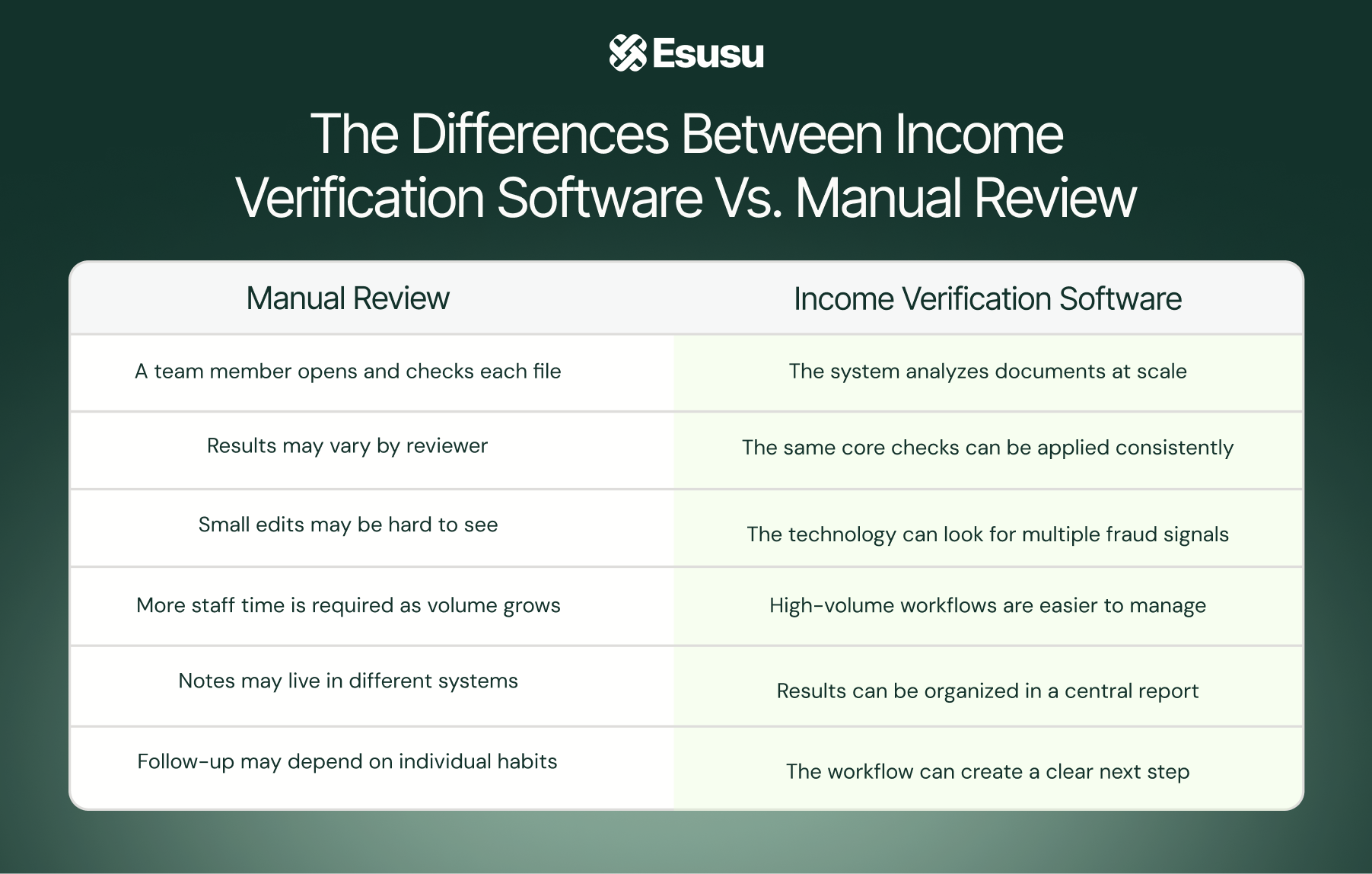
Automation should not remove accountability. Property managers still need written policies, trained employees, quality controls, and a process for handling incomplete or disputed information.
Features to Look For in Income Verification Software
AI-powered document analysis
The product should do more than read text. Look for analysis that can identify suspicious edits, inconsistencies, and patterns across the document.
Support for different document types
A solution should be able to handle the documents your applicants commonly submit, including pay stubs and bank statements. It should also make it easy to understand when a document type is not supported.
Fast, understandable results
Speed is important, but clarity matters just as much. A report should explain the result in plain language and make it clear when additional review is needed.
Property management system integration
Integration can reduce duplicate data entry and help teams keep the application workflow in one place. Ask which systems are supported, what information is transferred, and how permissions are managed.
Esusu Identity Services is designed to work with existing property management workflows. Applicants submit information through the established process, the documents are collected and reviewed, and leasing teams receive findings to support a faster decision.
To explore all the property management systems Esusu connects with, read our guide to Property Management System Integrations.
Bank linking and income calculation
Look for a workflow that lets applicants securely link a bank account or upload documents, then extracts relevant income data, aggregates it across supported sources, and presents a clear summary for human review. Learn more about Esusu’s Income Calculator.
Direct payroll verification
Some income verification platforms connect directly to payroll providers. This can provide structured employment and earnings data when the applicant gives permission and the provider supports the relevant payroll system. Payroll connectivity should complement, not replace, document analysis and bank linking, since coverage varies and applicants may have multiple income sources.
Strong data protection
Income documents contain personal and financial information. Ask how the provider encrypts data, limits access, manages retention, handles deletion requests, and responds to security incidents.
Human review options
Some files will be unusual, incomplete, or difficult to interpret. A good solution should provide a clear path for human review instead of forcing the system to make a final decision in every case.
Consistent and explainable policies
Technology should help property managers apply relevant screening criteria consistently. Avoid systems that provide a result without enough context to understand what it means.
Explainable decisions and audit trails
A useful system should show which information was reviewed, which rule or policy was applied, and why a file needs additional attention. Detailed records help teams answer questions, train staff, review exceptions, and demonstrate that similar applications were handled consistently.
Reporting and success metrics
Track measures such as time to decision, incomplete application rate, approval-to-move-in rate, early delinquency, follow-up volume, and fraud loss. These metrics help property managers understand whether a new workflow is improving both operational efficiency and decision quality.
How to Implement the Technology in Your Leasing Process
A successful rollout starts with the process, not the software.
First, define your written income policy. Decide which income sources you accept, which documents support each source, how recent the documents must be, and what happens when information cannot be verified.
Next, train the leasing team. Employees should know how to request documents, read a result, identify an exception, protect applicant data, and escalate questions.
Training also helps prevent staff from relying on intuition or applying different standards to different applicants.
Finally, review the process regularly. Fraud patterns change, software changes, and local rules can change. A process that worked last year may need to be updated today.
Fair Housing, Privacy, and Compliance Considerations
Income verification software can support a better process, but it does not remove the property manager’s legal responsibilities.
The Federal Trade Commission’s guidance for landlords explains that the Fair Credit Reporting Act can require an adverse action notice when a consumer report influences an unfavorable rental decision.
This can include denying an application, requiring a co-signer, or charging a higher deposit or rent. Requirements may depend on the type of information used and how it was obtained.
Fair housing rules also apply when technology is used. In its guidance on screening applicants for rental housing, the U.S. Department of Housing and Urban Development explains that housing providers and screening companies must avoid discriminatory screening practices, including when automated systems or artificial intelligence are involved.
Property managers should use relevant criteria, apply them consistently, document decisions, and review local requirements before launching a new workflow. This article is educational and is not legal advice.
How Esusu Identity Services Helps Property Managers Verify Income
At Esusu, we built Esusu Identity Services to help property managers identify signs of application fraud that may not be visible during a normal document review.
Our income verification solution gives applicants more than one way to provide proof of income.
They can upload documents such as pay stubs and bank statements or, when enabled, securely link a bank account through Plaid.
For uploaded documents, we use AI-powered document analysis to review pay stubs and bank statements for signs of tampering.
For applications with multiple sources, our Income Calculator can help extract, aggregate, and summarize relevant income information.
Together, these capabilities help leasing teams make faster, more confident decisions without relying on one verification path alone.
The goal is simple: help teams spend less time checking documents by hand and more time leasing homes responsibly.
By adding a stronger verification layer to the existing application process, property managers can protect net operating income while keeping the experience clear for legitimate applicants.
Frequently Asked Questions
Final Thoughts
Income verification is now a core part of modern rental operations. As fraudulent documents become easier to create, a quick visual check may not provide enough protection for a property or a leasing team.
Income verification software helps close that gap by combining speed, consistent analysis, and clearer reporting.
The right solution can support faster leasing while helping property managers identify suspicious information before it becomes a costly resident placement.
For property managers looking to strengthen their application process, Esusu Identity Services provides an AI-powered way to review income documents and support more confident decisions.
DISCLAIMER: Esusu Identity Services is designed to support, not replace, a property’s established screening policies and human review process. No technology can guarantee the detection of all fraudulent documents.