



Applicant income does not always arrive in one clear document. A reviewer may need to examine multiple paystubs, bank statements, connected bank accounts, or income from more than one job. Payments may also arrive on different schedules or be spread across several accounts.
To build a clear income picture, leasing teams may need to locate relevant transactions, separate income from unrelated deposits, calculate totals, and compare the result with the property's rent requirements.
Completing those steps manually can seem manageable for a single application. But when the same process is repeated across hundreds or thousands of applications, small manual tasks can create significant operational costs, and those costs are not limited to staff time.
Key takeaways
- Applicant income may be spread across multiple documents, jobs, accounts, and payment schedules.
- Manual income review can create rework, inconsistent calculations, application delays, and manager oversight.
- Measuring review time and rework can help property teams understand the true operational cost of their current process.
- A more structured workflow can make income information easier to review without replacing property policies or human judgment.
- Property teams can download a free worksheet to estimate their own monthly and annual manual review costs.
Why manual income review can become difficult
Manual income review often requires leasing teams to build a complete income summary from information that was not submitted in one consistent format.
One applicant may provide a single paystub from one employer. Another may provide income from multiple jobs, weekly and biweekly payments, several bank statements, deposits across multiple accounts, connected bank account information, and supporting documents that require additional interpretation.
Each additional source may require the reviewer to complete more steps before reaching a clear income total: opening each document or account, finding the transactions that appear to represent income, separating recurring income from transfers or unrelated deposits, interpreting different payment schedules, adding income from multiple sources, completing an income-to-rent comparison, and documenting the calculation for the final review.
When those steps happen outside a structured workflow, the process becomes harder to complete quickly and consistently.
The cost goes beyond time spent reviewing documents
The most visible cost of manual income review is the time employees spend examining documents and calculating income. But the broader operational impact can be much larger.
1. Rework
A missing transaction, unclear document, or calculation error may require a second review. The team may also need to contact the applicant, request more information, reopen the application, and repeat parts of the calculation. Even when the additional review takes only a few minutes, that time can add up across a large number of applications.
2. Inconsistent calculations
Different reviewers may organize or interpret the same information differently. One employee may include a certain type of deposit while another leaves it out, and reviewers may use different methods to convert weekly, biweekly, or irregular payments into monthly income. The property's qualification policies may stay the same, but the process used to prepare the income information can vary.
3. Slower application decisions
The longer it takes to organize income information, the longer it may take to move an application forward. Delays become more noticeable during high-volume periods, when reviewers are already managing several applications at once.
4. Manager oversight
Managers may need to verify calculations, review unclear transactions, or resolve differences between reviewers. That creates additional work for people who may already be responsible for leasing performance, team support, resident issues, and property operations.
5. Difficulty scaling
A manual process may work for one property or a small number of applications. It becomes much harder to manage consistently across multiple properties, different leasing teams, higher application volumes, several markets, and different applicant income profiles.
How much could manual income review be costing your team?
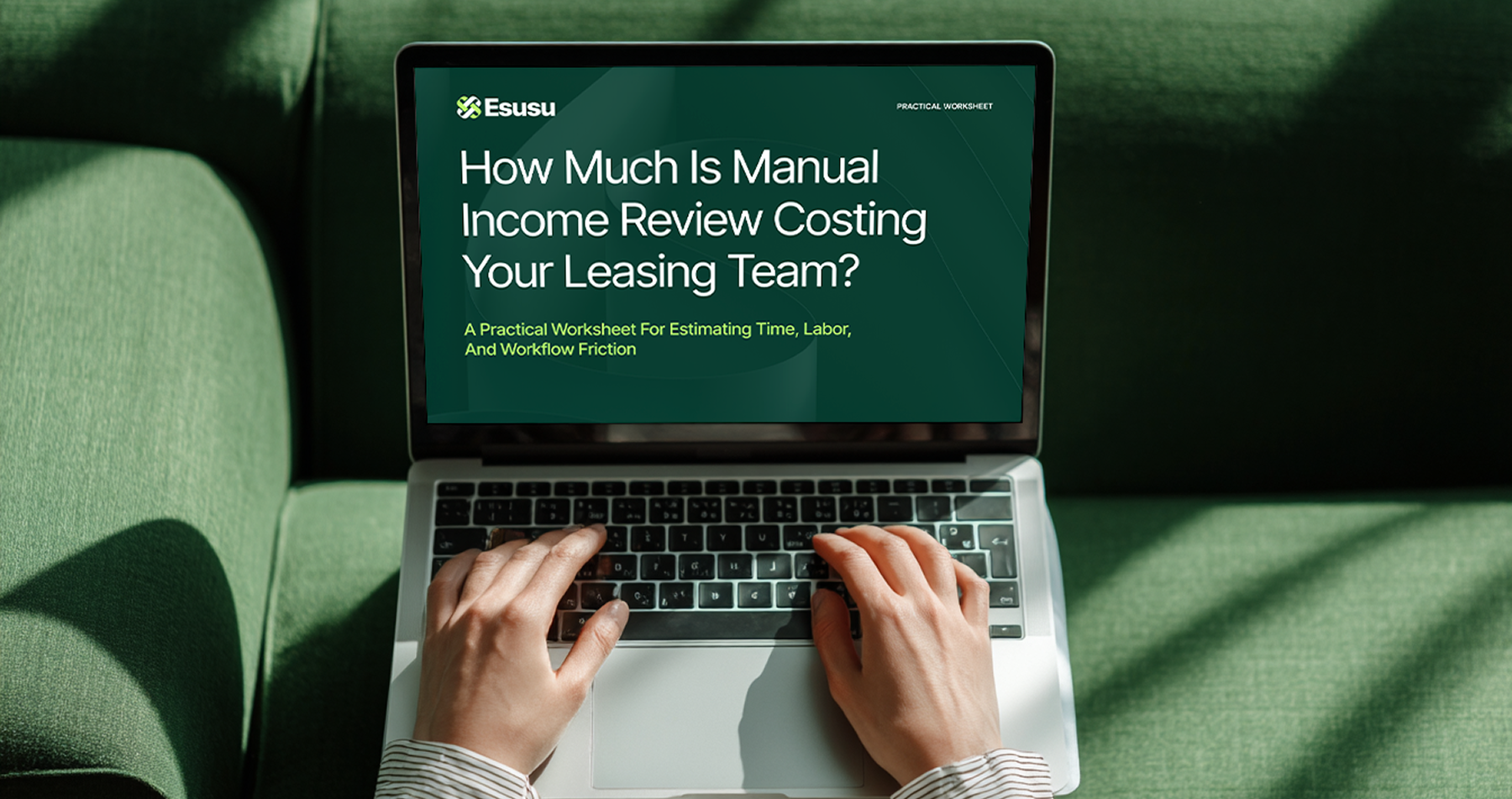
Our free worksheet helps you estimate review hours, labor costs, rework, and workflow friction based on your own application volume.
Signs that your current workflow may be creating friction
A manual process does not need to be completely broken to create avoidable work. A few common signs include:
- Reviewers regularly scan several pages to find income information.
- Applicants often submit income from more than one job or account.
- Reviewers add income from multiple sources using calculators or spreadsheets.
- Applications often require additional documents or a second review.
- The process differs between properties or reviewers.
One or two manual steps may not seem significant on their own. The concern is how often they occur and how much work they create when repeated across the portfolio.
The downloadable worksheet includes a complete self-assessment property teams can use to identify whether their current workflow is manageable or creating meaningful operational friction.
Why property teams should measure manual review work
It is difficult to improve a process without understanding its current impact.
Property teams can begin by gathering a few basic numbers: how many applications require income review each month, how long the initial review usually takes, the approximate hourly cost of the employees completing the review, what percentage of applications require a second review, and how much additional time that rework requires.
With those inputs, a team can estimate monthly review hours, monthly and annual labor costs, and the added cost of rework.
This calculation will not capture every possible cost, since it may leave out time spent requesting missing documents, manager oversight, delays, lost productivity, or inconsistent application decisions.
Even so, it gives property teams a useful starting point for evaluating the current workflow and building a clearer case for improvements.
The gated worksheet walks through each formula and includes fields teams can complete using their own operational numbers.
What manual income review can look like at scale
Consider a hypothetical portfolio or group of communities reviewing 500 applications each month, where each initial review takes about 15 minutes, staff cost is around $30 per hour, and 20% of applications require an additional 10-minute review.
Under those assumptions, the estimated staff cost reaches roughly $4,250 per month, or about $51,000 per year.
This example is illustrative, not an industry benchmark, and actual costs will vary based on staffing, workflow, application volume, documentation, and average review time.
It also only measures staff time. It does not include the potential effect of application delays, calculation inconsistencies, manager involvement, or workflow bottlenecks.
But the point is simple: a few minutes per application can become a significant annual expense at scale.
What a more efficient income review process should provide
Improving the income review workflow does not mean removing the property team from the decision. The goal is to give reviewers a clearer and more consistent starting point. A more efficient process should help teams:
Bring supported income sources together
Reviewers should be able to understand information across supported paystubs, bank statements, and connected accounts without treating every source as a completely separate workflow.
Reduce manual scanning
Teams should spend less time reviewing every page or transaction simply to locate relevant income information.
Organize income into a clearer view
Reviewers should receive a structured summary instead of building one manually for every application.
Support easier income-to-rent analysis
The process should make it easier to understand the applicant's available income and compare it with the property's requirements.
Improve consistency
A more repeatable process helps different reviewers and properties organize income information in a similar way.
Preserve human judgment
Technology should support applicant review, not make the final qualification decision. Property teams must continue applying their own policies, reviewing the available information, and deciding whether the applicant meets their requirements.

How the Esusu Income Calculator can help
The Esusu Income Calculator is a capability within Esusu Identity Services' Income Verification solution. It helps property teams understand applicant income by pulling income-related information from supported sources, including paystubs, bank statements, and connected bank accounts through Plaid.
For information about how Esusu handles applicant data, including data accessed through connected accounts, please refer to Esusu’s Privacy Policy.
The Income Calculator brings this information into one clearer view and helps calculate and summarize income across multiple documents and accounts.
This can reduce the need for leasing teams to manually scan and total income information, support easier income-to-rent analysis, and create a more consistent review process across applications and properties.
The feature does not make the final qualification decision. Property teams continue to apply their own policies, review the information provided, and determine the appropriate outcome.
Property teams are responsible for ensuring that their qualification criteria, including any income-to-rent requirements, comply with applicable federal, state, and local fair housing laws, including any source-of-income protections that may apply in their jurisdiction
Income Verification is one part of a broader platform. Esusu Identity Services also offers Identity Verification and SSN Verification, so property teams can evaluate different types of risk during the application process through one connected experience.
Start by understanding your current cost
Manual income review is not only a document-processing task. It can affect employee workload, application speed, calculation consistency, manager capacity, workflow scalability, and the overall applicant review experience.
So understanding the current cost can help property teams identify where process improvements may have the greatest operational value.
See what manual income review may be costing your team. Download the free worksheet to assess your current workflow, estimate monthly and annual labor costs, and build a clearer case for process improvements.
FAQ About Manual Income Review